The Breath


March 14
A Day to Remember?
When surprises – good or bad – materialize from Nowhere,
how does one control a ‘gut’ reaction?
And today my Mind grabbed my Spirit and they traveled
to the place of Resolution when my Phoenix Osteopath was unable to activate the ‘trigger’ for the Temporalis Tendon with his oral palpation.
Has Tendon finally calmed down and decided to rest?
Resolution is a dangerous place to visit. I’ve been there before.
Within twenty-four hours, Body would scream differently,
overriding my Mind and assaulting my Spirit.
And, in the past, my Spirit recovers, picks me up
and we continue onward together.
….Unbridled into Boundlessness in our Liminal space of Potentiality.
– A Space where both hope and fear reside – where both joy and grief dwell. A Space of Transformation where both Paradox and Potentiality reign
within a Boundless Presence.
and I remember September …on the Way to San Jose.
By combining the words of hope and fear,
Pema Chodron transports me to an expanded
realm of understanding which gives birth to COURAGE.
the word for fear is dokpa.
“REDOK: A feeling with two sides…
as long as there’s one there’s the other.”
(When Things Fall Apart, p. 39)
If hope and fear are two sides of one coin,
so are Hopelessness and Confidence.
If we’re willing to give up hope that insecurity
and pain can be exterminated,
then we can have the Courage to relax with the Groundlessness of our situation.
Hopelessness is the basic ground.’”
(When Things Fall Apart, p. 41)
I juggle her words, preferring the word Groundlessness to Hopelessness (the basic ground).
Is Groundlessness, therefore,
the same as Surrender…
Where both Trust and Confidence are born
and reside in the Ground of Being
with the Boundless Presence….
Boundlessness – Groundlessness – Hopelessness
A Space where the Vital Force, the energy of life vibrates,
expanding and contracting as does our Breath
…as does the flexion and extension of the CRI (cranial rhythmic impulse)
where we can touch this ‘Vital Force’.
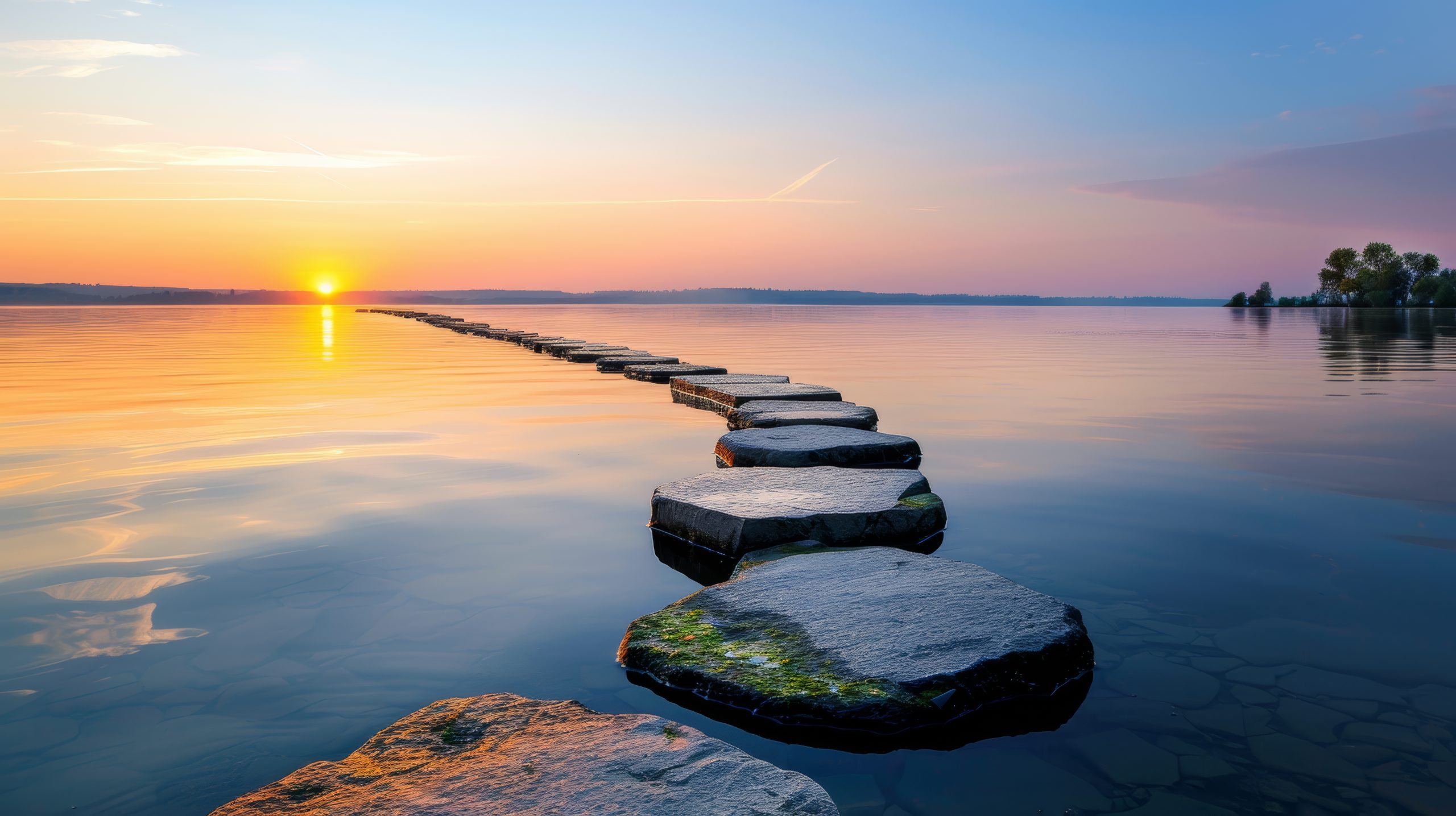
The Stepping Stones of Change
Navigating Change with The Breath
Navigating change in your body is quite the experience.
Most underestimate the power of the body to change in a positive direction when symptoms manifest loudly.
I am most thankful for my many years of living into and through a flare after treatment or I would not be able to persevere and continue onward as the rapid and radical symptoms appear and disappear within hours and sometimes minutes.
Symptoms that would take days to resolve are here today and gone today.
One step at a time.
In addition to my years of slowly moving into this space with cranial oteopathic treatment,
I also have a breathing technique that amplifies the symptom(s) at times.
As I sit and breathe with this manifestation, radical change unfolds.
One step at a time.
My Breathing Technique involves POSITION.
I am fortunate to have a zero gravity chair
which immediately shifts my center of gravity to zero.
I am remarkably aware of my Body entering a pervasive shifting
of symptoms as the chair slowly reclines.
And thus I enter into a different world of communication with my Body.
My Breathing Technique integrates FIVE PRACTICES
1- Inhalation with Expansion (flexion) and
Exhalation with Contraction (extension) and
The Swallow
INHALATION and EXHALATION + The SWALLOW
James Nestor’s best-seller Breath was the primary impetus behind my investigation into orthodontics in the early stages of The Cranial Connection website development. Much has evolved since December 2023 when I purchased this book. My big take-away from this book was the importance of the exhalation and the importance of carbon-dioxide. I was ‘Breathing with Brahms‘ and had an exemplary inhalation of 32 measures; however, my exhalation was nowhere equal to this. My breathing took a radical change of direction and form as well as tempo.
It was this book that introduced me to facial development, maxillary expansion and the swallow. And by March of 2023, I was enrolled in an on-line course with an orofacial osteopath, Tasha Turzo, DO – the queen of the swallow and its significance in the osteopathic cranial concept.
I created what I have labeled as ‘cranial breathing’, which thus incorporated a swallow. This technique has been refined during the past year.
Inhalation is a phase of gentle expansion (widening or ‘flexion’). The tongue should rest in the roof of the mouth. As the inhalation deepens, the palate widens with a light force from the tongue on the upper back molars; simultaneously, the belly expands. The entire body widens from head to toe, maxillary palate to the arches in the feet! At the apex of this very slow gentle movement, there is a pause (maybe a slight holding of the breath). The Exhalation gently arises with a lengthening ‘extension’ creeping in as the tongue continues to rest on the palate and the belly flattens and elongates to the feet. At the end of the exhalation phase, the swallow occurs, which widens the palate and the process begins again.
The awareness of the Swallow has become paramount for me personally – a person who never swallowed correctly. The intubation injury and later collapse of the left palate with surgical intervention compromised whatever swallow I had before 1996 – 1998. The maxillary expansion with the tongue lands precisely in the area of trauma in my case. Incorporating a ‘functional swallow’ into my breathing practice has been monumental during the past year.
This ebb and flow, this expansion and contraction, this flexion and extension with the breath and the swallow is coordinated with meditation, Jin Shin and Sunin Do. Subtleties emerge as the experience matures and blossoms. I find that music, which has a meter as well as a tempo, can enhance the process. Music can override thought as well as entrain a rhythm with the phrase as well as tempo (speed). But then I am a musician…so this may or may not be relevant for all.
MEDITATION
I was first introduced to meditation because of unsuccessful back surgery! I enrolled in a Transcendental Mediation (TM) class for pain control. I was attempting to avoid seeing a doctor for one year and not take any prescription drugs in order to qualify for a Blue Cross Blue Shield private insurance policy. My ‘Prognosis Protest involved three ‘disciplines’: meditation, Jin Shin Jytusu and a TENS unit. I qualified for the policy after a year. I was 30 years old when I first set forth on a ‘Road Less Traveled’.
My early experiences with TM introduced me to a very different sense of the God that was in my Presbyterian and Methodist churches. And I was ‘hooked’ into this different form of prayer. As the years unraveled, other forms of meditation were explored: Christian Meditation, Centering Prayer, and the 99 Beautiful Names of God in the Sufi tradition. Stillness and silence is a common goal and how you get there includes many different routes.
I became acquainted with Neil Douglas Klotz, a Sufi murshid (teacher), and his Aramaic Jesus many years ago. Klotz is a renowned writer in he fields of Middle Eastern spirituality and the translation and interpretation of the ancient Semitic languages of Hebrew, Aramaic and Arabic. I created my own ‘mantra’ or ‘prayer’ from the Aramaic: Alaha Ruha. Alaha – translated as Reality or God. The word roots point to the union of “yes’ or ‘something’ and ‘no’ or ‘nothing’. ‘Ruha‘ – the larger breath of Reality that holds us. It continues before our physical birth to after our physical ‘death’ or ‘transition’. Other words for ruha are soul, wind, air, or spirit.
As in TM or Centering Prayer, these two words appear as meditation begins and return when the ‘monkey mind’ of thoughts enters our awareness. Alaha is inhalation and Ruha is exhalation. A recent release, The Aramaic Jesus Book of Days (2025) by Klotz, is the latest of his many publications over the past 40 years. This small book is a superb introduction to Klotz and ‘Aramaic’.
Jin Shin Jytusu entered my life during the late 70’s after my second failed back surgery that was accompanied with a devastating prognosis. Jin Shin was my ‘prognosis protest’. My son’s best friend was Japanese; his mother gave me a referral to a Jin Shin practitioner. Little did I know at the time that this was my first step ‘out-of-the-box’ into the Unknown as I began my long journey in the Beyond.
The Main Central Vertical Flow is one of the first flows is taught in this ‘self-help’ practice. Accompanying this primary pathway are the Mediator (or Supervisor) Flows. Your light touch waits for the sense of a pulse.
What is the practice? Waiting into relaxation in stillness while both hands are lightly touching the body at different ‘energy locks’ while becoming aware of synchronization or ‘harmonization of pulses between the hands.
‘Harmonizing the Body’ with the Main Central Vertical and Mediator Supervisor Flows – whether waking up, falling asleep or during the day for a quick rejuvenation – is habit at this point in my life. This light touch is incorporated with breathing, meditation and Sunin-Do. Recently, my Phoenix osteopath gave me the name of a practitioner in the area, and Jin-Shin once again became more than a ‘self-help’ modality.
SUNIN DO and SUNKONG
In the Korean world of Sunin Do, everyone and everything is born with the self-healing power of Ki energy; Korean Ki, Chinese Chi, Indian Prana, Japanese Qi…all are different labels for this energy of Life. Sunin Do had a meditative practice called Sunkong – rhythmic breathing with slow movement in sitting, standing or reclining postures.
One of the postures has accompanied me since becoming acquainted with this Korean practice….Dori-Dori. In a sitting posture, the head is turned very slowly from side to side. The head was considered the ‘antennae’ to locate Ki and to discern Truth from God (the Creator, the Source, the Un-nameable). The movement process included slow exhalation and inhalation while turning the head and holding the breath at the end of the side movements of exhalation and inhalation.
Dori Dori became a part of my life in the early 2000’s, joining my Jin Shin ‘touch’ and ‘pulses’ of the late 70’s. I fashioned my own combination of these Japanese and Korean practices with meditation.
LASER Light

The unbelievable power of vibration:
nanometer (nm) frequencies of light and hertz (hz) frequencies of sound.
The music posted on this website can make me ‘shimmer’ as well .
A NightLase® treatment is commonly used for snoring and sleep apnea. The laser heats the tissue gently and tightens the tissues in the back of the throat. The success rate of NightLase® is up to 85%, usually with three treatments. This laser uses two frequencies of light: 1064 nm and 2940 nm.
In my case, tightening the tissue in the throat could potentially address Tensor ‘flopping around in the tissue’ as well as Raphe and his ligamentous instability.
Breathing can be integrated while using the laser. In fact, the ‘shimmering’ effect I feel from the light is sometimes reproduced with my breathing practice. Widening the palate/breath seems to increase the ‘effect’ of the light…more shimmering. The exhalation then can equally produce more shimmering when integrated with the Breath… and the quality of pain slowly shifts.
Metamorphosis?
“The Space Between the Breath”
Scalar Energy and Stillpoint
An Oralase,™ a 1064 hot laser, reduces pain and inflammation. This light therapy helped release the fibrous tissue in my neck and jaw that had violently reacted during first month of adjusting to the dental splint as my bite shifted to the right and my teeth were ‘whamming’ on the splint.
A cold laser was recommended for at-home treatment. My Scalarwave laser does a remarkable job of ‘shimmering’, shifting the quality of the sharp, painful sensation… and sometimes eradicating it completely. This cold laser is now my ‘go to’ for home change and/or relief. And the astounding discovery is that this ‘shimmering’ reflects back into the painful area from wherever the laser is resting on my body.
The cold laser ‘substitutes’ for Jin Shin in my practice since it takes one hand to use the laser and Jin Shin uses both hands. Breathing, Sunin Do (slow head movement) and meditation are companions with a cold laser treatment.